
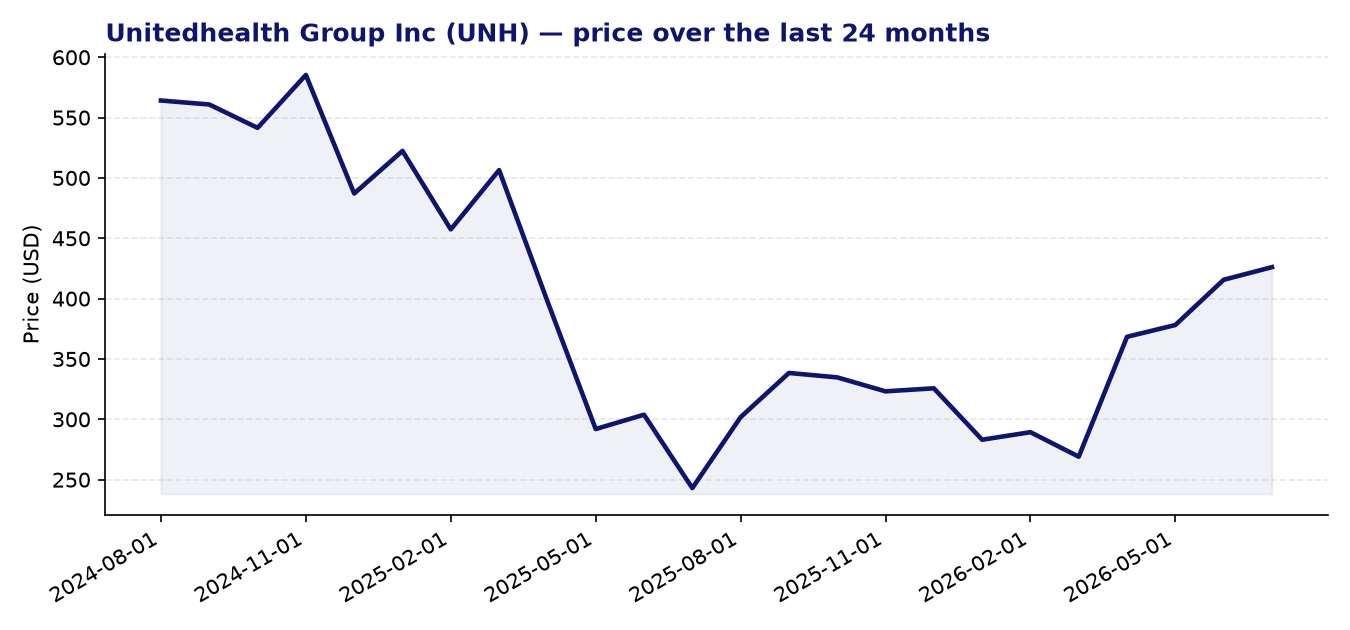
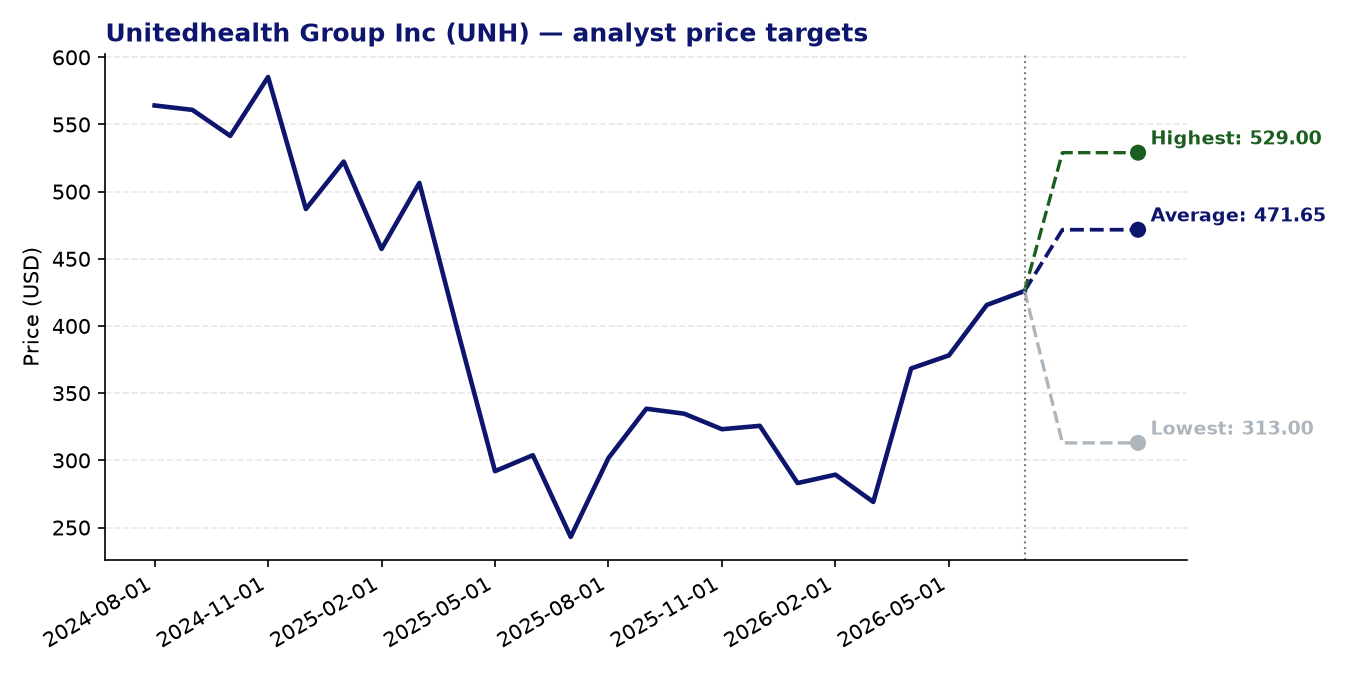
Unitedhealth Group Inc (UNH) — current price: 426.09 USD | average price target: 471.65 USD | potential: +10.7%
About Unitedhealth Group Inc
- UnitedHealth Group is one of the largest diversified healthcare companies in the US, operating across health insurance, care delivery, pharmacy benefits, and health data analytics.
- Its UnitedHealthcare segment provides health benefit plans to employers, individuals, and government-sponsored programmes including Medicaid and Medicare.
- The Optum division comprises three units — Optum Health (care delivery and management), Optum Insight (data analytics and software), and Optum Rx (pharmacy benefits management) — giving the group significant vertical integration.
- Founded in 1974 and headquartered in Eden Prairie, Minnesota, the company serves a broad range of clients from large national employers to economically disadvantaged populations through state and federal programmes.
Recent news
- UnitedHealth’s second-quarter 2026 results exceeded analyst expectations, with earnings per share and revenue both coming in ahead of forecasts, prompting the stock to reach its highest level in over a year.
- A notable improvement in the medical cost ratio — the share of premiums spent on patient care — came in meaningfully below consensus estimates at 86.7%, signalling better cost discipline than the market had anticipated.
- Management raised its full-year 2026 adjusted EPS guidance to a range of $19.50–$20.00, up from the previous floor of $18.25, reflecting greater confidence in the group’s financial trajectory.
- Bank of America upgraded the stock to ‘Buy’ in early June and subsequently raised its price target to $450, citing the company’s improving fundamentals and the stock’s momentum heading into the summer.
Strengths
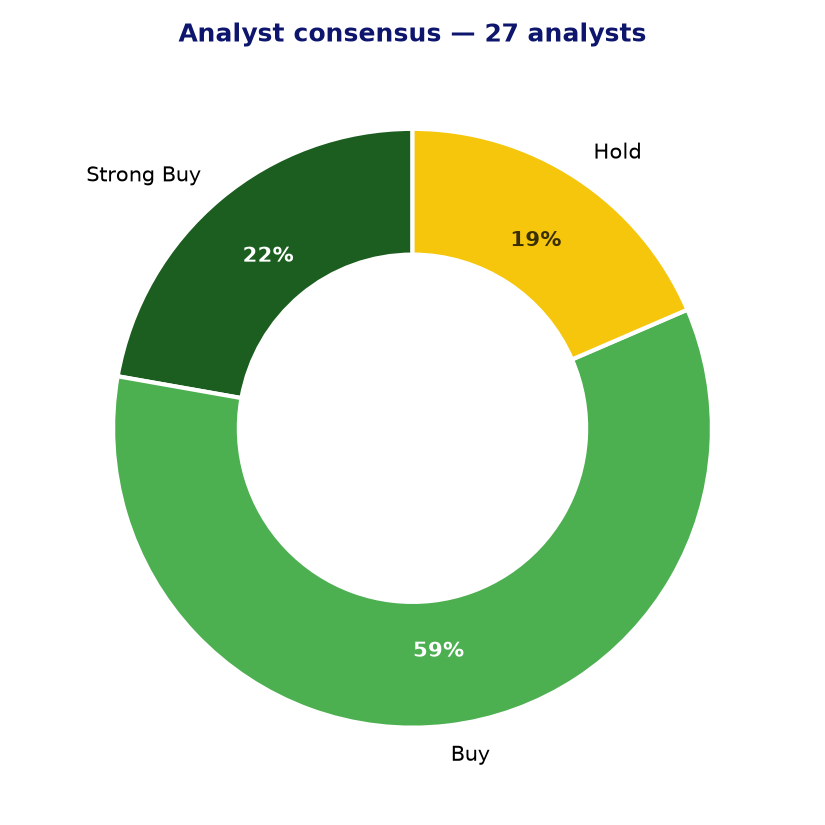
- Analyst sentiment is strongly constructive: 22 of 27 covering analysts rate the stock either ‘Buy’ or ‘Strong Buy’, with a consensus price target of $471.65 implying approximately 10.7% upside from the current price.
- The 24-month Z-score momentum reading of 2.70 indicates that the stock has shown meaningful positive price momentum relative to its recent history, a factor that can attract further institutional interest.
- The forward P/E of 19.24 is considerably more moderate than the trailing P/E of 32.06, suggesting the market anticipates meaningful earnings growth ahead and that the valuation becomes less demanding on a forward basis.
- Vertical integration across insurance, care delivery, pharmacy, and data analytics provides diversified revenue streams and potential cost efficiencies that many pure-play health insurers cannot replicate.
- The raised guidance and improving medical cost ratio suggest that earlier operational pressures are easing, strengthening the investment case for those focused on earnings recovery.
Points of attention and risks
- At a trailing P/E of 32.06 and a PEG ratio of 1.42, the stock is not inexpensive relative to its growth rate, leaving limited room for multiple expansion and making it more sensitive to any earnings disappointment.
- EPS growth of 0.61 (on a trailing basis) is modest for a company carrying a premium valuation, and investors are largely pricing in a recovery that still needs to be sustained over several quarters.
- The wide spread between the lowest and highest analyst price targets — $313 to $529 — reflects a meaningful divergence of views on the stock, highlighting genuine uncertainty about the pace and durability of the turnaround.
- The healthcare plans sector faces ongoing regulatory and political risks, including potential changes to Medicaid reimbursement rates, Medicare Advantage funding, and broader US healthcare policy, any of which could weigh on revenue visibility.
- UnitedHealth has faced reputational and operational challenges in recent periods; while Q2 results suggest progress, sustained improvement in cost management and public trust will be important to monitor in coming quarters.
Analyst consensus and price targets
Conclusion
UnitedHealth Group’s second-quarter results and raised guidance mark a meaningful step in its operational recovery, and the strong analyst consensus alongside a 10.7% average price-target upside reflects genuine confidence in the group’s diversified model. However, the trailing valuation remains elevated for a business with modest near-term earnings growth, and sector-level policy risk is a persistent consideration for any healthcare plan operator. Investors may find the forward earnings picture more reassuring, but the pace of the recovery and the regulatory environment warrant continued attention before drawing firm conclusions.
This article was compiled by the Wall Street Stock Investors Club team based on analyst data on 18-07-2026. Not investment advice.